
How to Measure a Door for a Perfect Fit at Home
Measuring a door needs to be done with optimum accuracy if you want to avoid draughts, any sticking and achieve the perfect fit. Our guide will clarify how to go about it, providing expert advice on precise measuring in millimetres for both existing frames and new door sets. We’ll also give direction on gaps, floor coverings and when to go bespoke.
- Do I measure the door or the frame?
For a typical front door replacement, measure the actual frame, not the existing door, as it may have swelled or shrunk over time. The frame will offer a true opening, helping you get sizing right. But, because we always replace the frame too, we recommend brick-to-brick measuring for this particular step. If no frame exists, use your metal tape measure to get a brick-to-brick recording, deducting the frame size from that measurement so a new door fits seamlessly. - What gaps should I leave around a door?
So a door doesn’t catch when being opened and closed, leave some small, even gaps around the edges while recording door measurements. Around 3mm at the top and sides and approximately 9mm at the bottom will suffice to stop it scuffing on your carpet or rug. Most types of doors (specifically new doors) have a degree of lipping (a solid timber strip along the edges) so that a door fitter can slightly plane or trim a door to get the required clearance. - What are internal doors standard sizes in the UK?
When looking to learn how to measure a door, be aware that manufacturers generally work to a group of common door sizes. The most typical size is 1981 x 762 x 35 mm (roughly 6’6” × 2’6”), but there can be slight anomalies. Here are a few additional average UK internal door sizes:- 1981 × 610 × 35 mm (6’6” × 2’0”)
- 1981 × 686 × 35 mm (6’6” × 2’3”)
- 1981 × 838 × 35 mm (6’6” × 2’9”)
- 2040 × 826 × 40 mm (metric size)
Consider door thickness too, as fire-rated doors (FD30) exceed the thickness of standard internal doors by around 9 mm (44 mm against 35 mm).
Work to the closest standard size and confirm trimming options ahead of placing a bespoke order for the strongest front door.
- How do I measure when there’s no frame?
Without an existing frame, measuring doors must involve direct measurement of the brickwork opening. Get the width brick to brick in a straight line across the top, middle and bottom of the opening and jot down the smallest measurements. For the height, go brick to brick in a straight line on the left, centre and right sides of the opening, recording the smallest measurement again. Using these dimensions, you can calculate the required door set size, so long as you deduct the specified allowance. It’s better to have an oversized opening than undersized, as an installer can pack and trim around an undersized frame if necessary.
Request Your Free Door Quote
Simply fill in your details for your free, no obligation quotation
Measure an opening with a frame (replacing an internal or external door)
Measuring for a doorset, when looking to replace an internal or external door, customarily sees the measuring of the existing opening with the door frame in situ.
How to measure a door frame in this instance calls for measurements to be taken from the inside to ensure the new door fits nicely in the existing frame structure.
Let’s talk you through it in numbered steps:
- Collect the width with a measurement of the distance between the inside edges of the frame at the top, middle and bottom. The smallest measurement is the crucial recording.
- Door height is captured by measuring from the top frame to the floor (or threshold, if there is one) at several points. Once more, use the smallest measurement.
- Don’t forget to also measure the depth of the door frame and the door rebate (this is where the door sits within the frame) for the right alignment.
- Be mindful of whether the door opens inwardly or outwardly and whether it is left- or right-handed so that it correctly hangs.
- Finalise the measuring process by checking the frame is perfectly square, which you will uncover by measuring diagonally from corner to corner.
Door width (inside the frame)
The vertical part of a door frame that forms the sides of the doorway is referred to as the jamb:
- Measure the inside width of a door frame from jamb to jamb.
- You know the drill by now as to where to measure from – the top, middle and bottom of the frame.
- Note the widest reading for when you come to order a new door, as it will aid with fitting the design and make it less likely that any trimming needs doing.
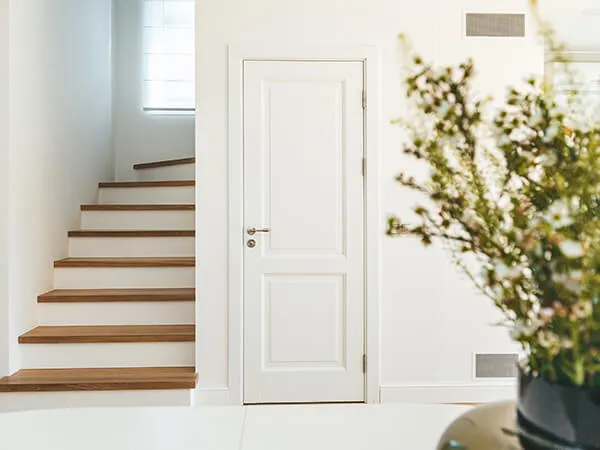
Door height (finished floor to underside of head)
There are certain steps to follow on how to measure a door frame for height:
- Measure from the finished floor (or threshold) to the underside of the door frame.
- Do it from the left side, centre and right side of the doorway.
- The tallest measurement will give you the required height recording and stop the door scraping the floor or threshold.
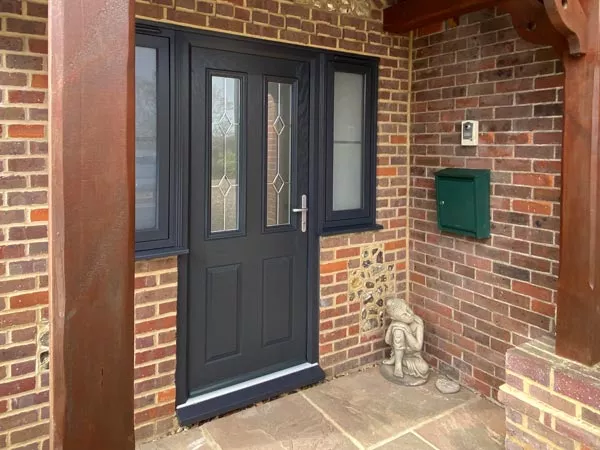
Door thickness & frame rebate
When measuring doors, it’s essential for fitting that you measure the door thickness and the rebate, and it’s easy enough to sort.
- Identify the edge of the existing door (the side that sits inside the frame when closed) and then measure the thickness from one face of the door to the other with a ruler.
- Go about measuring the rebate with a measurement of its width and depth.
- To get a flush fitting door that firmly seals when closed, the replacement door’s thickness needs to complement the frame rebate.
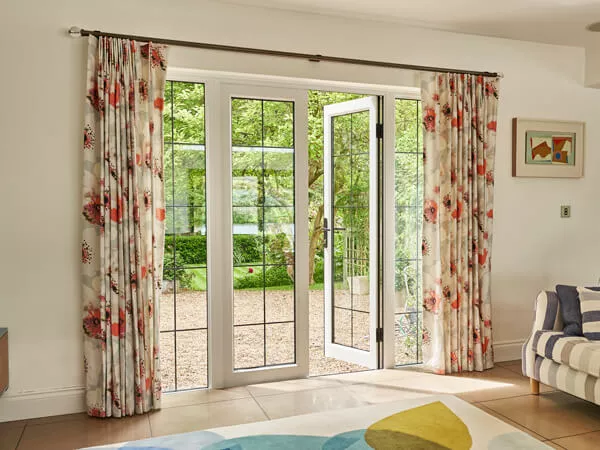
Tools, prep and the golden rules
The risk of ending up with an ill-fitting door can be reduced if you have the relevant tools and prepare properly. All you need to be armed with is a rigid metal tape measure and pencil and paper.
Whether you’ve chosen a modern grey front door or something else, don’t proceed with measuring until any obstructions have been cleared away and door stops and trims are removed.
Measurements in metric millimetres are vital for precision and take down the smallest measurements for width, height and depth. Double-check these measurements in case of any misjudgements before pressing ahead with an order.
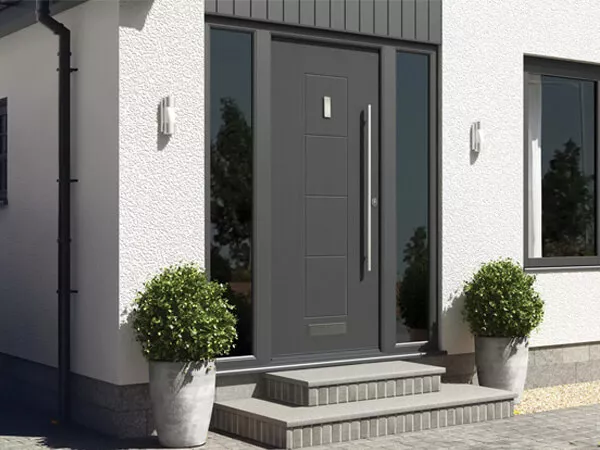
Clearances, trimming and floor coverings
A key bit of instructional advice on how to measure a door is to account for required clearances around the edges.
A clearance of about 3mm at the top and sides and 9mm at the bottom should be enough for smooth door operation and prove advantageous if expansion or contraction transpires in future.
So that carpet or tiling doesn’t interfere with door manoeuvring, the bottom clearance needs enough of a gap.
Observe the trimming limits outlined in manufacturer guidelines to ensure that you end up with a brand-new door that fits neatly and works a treat.
Remember to look into the best front door colours while in the door shopping phase.
Map your measurements to UK sizes (and when to go bespoke)
Once you’ve gathered your measurements, see how they match up to the UK’s common standard internal door sizes, varying from widths of 540mm to 838mm, heights of 1981mm or 2040mm and thicknesses of 35 to 44mm.
Deduce if a standard door will fit by calculating the expected gaps; 2-3mm at the top, 2mm each side and 8-10mm at the bottom for clearance. A standard door will be suitable if trimming can achieve these clearances.
Going bespoke is the safest option if an opening far exceeds the standard dimensions, the frame is particularly out-of-square, or a non-standard thickness is demanded.
If you feel a bit out of your depth measuring a door, leave it to the experts at Hazlemere to sort – it’s all part of the service when buying one of our designs. We’ll send someone round to inspect the opening and obtain the precise dimensions in readiness for your chosen door being installed.















REQUEST YOUR FREE QUOTE
Simply fill in your details for your free, no obligation quotation, and click "Get Quote"
Want to speak with an Advisor? Give us a call on 08000 825 825
Our friendly team will be pleased to help with any questions you may have.